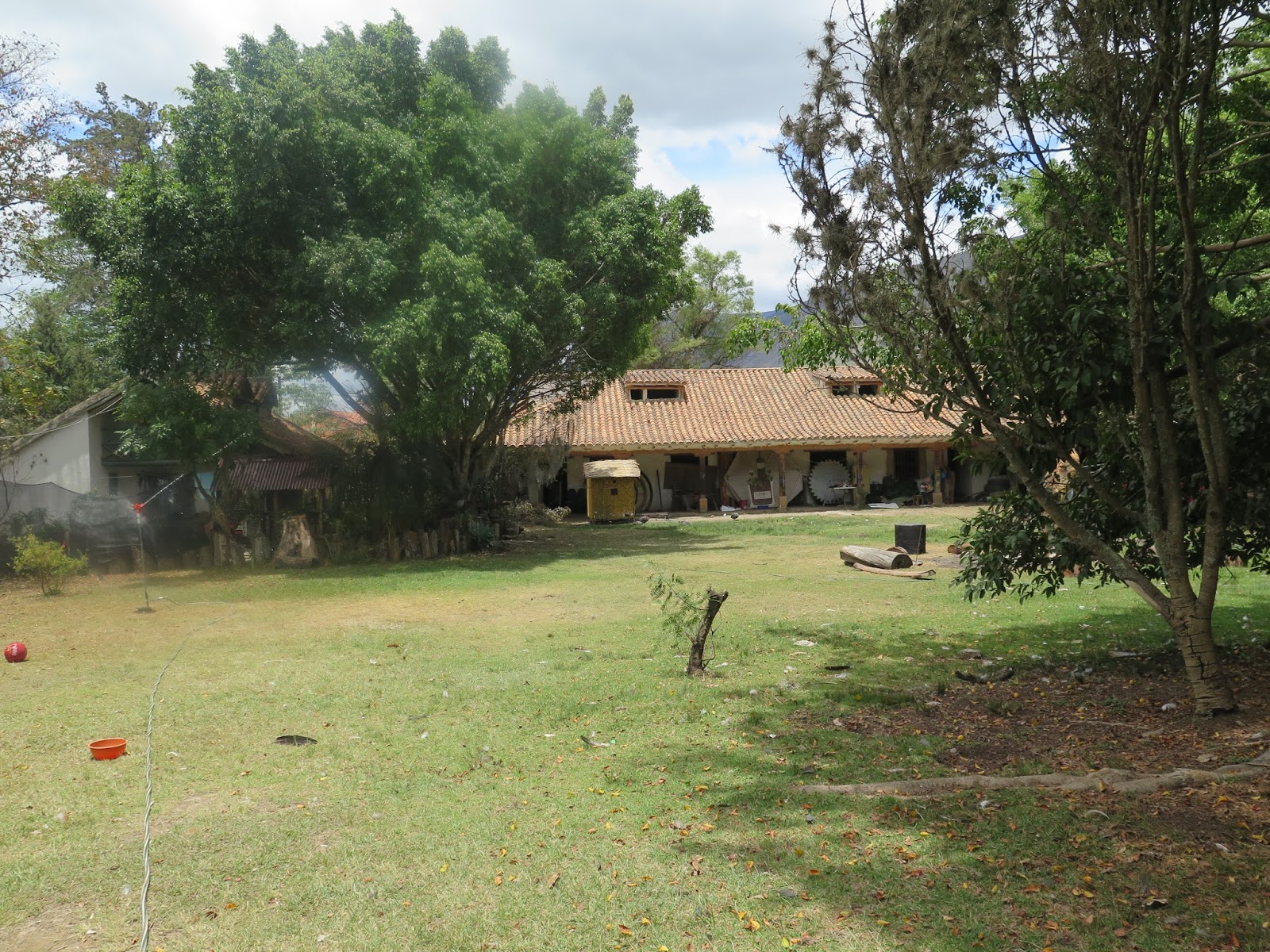
Pikachu
Pikachu es una Suzuki DR-X de 200 c.c. modelo 2017.
En Colombia son bien conocidas las Suzuki DR200 (las usa hasta la policía) pero casi nadie conoce la DR-X (sí señor(a) así nomás, sin el 200). Mejor dicho son la misma vaina, pero Pikachu tiene unos plásticos que la hace ver más bonita. Parece ser que desde el 2015 han venido vendiendo la DR-X como una nueva versión de la DR200.
 |
| Pikachu DR-X 200 cc |
 |
| DRX de la policía en Bogotá |
Comparando la información que hay en internet, parece que se perdieron 0.5L de capacidad con los nuevos plásticos (Pikachu tiene de capacidad 12.5L y una DR200 tiene 13L). Todos los demás parámetros parecen ser los mismos.
¿Qué le agregamos a Pikachu? Dos Exploradoras LED, puños calefactables, dos puertos USB para cargar dispositivos, un indicador de batería, un cable de conexión permanente para la batería (el cual nos permite cargar la batería sin tener que desmontarla de la moto), una pequeña caja de fusibles con un pequeño relé, una montura para montar la cámara fotográfica o el celular, las alforjas (las alforjas de Carolina no necesitan porta alforjas), una parrilla para cargar una maleta, defensas de motor, cubremanos, una pequeña maleta en el guardabarros delantero para almacenar un neumático y una caja de aluminio para almacenar cosas varias.
 |
| Exploradoras LED - LED Lights |
 |
| Interruptor de las exploradores LED - LED Light's switch |
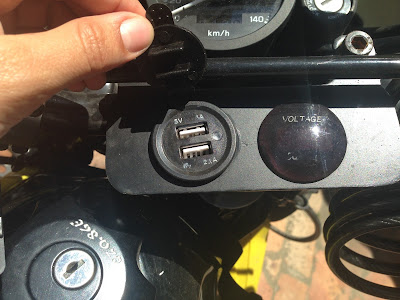 |
| Puertos USB e indicador de batería - USB Outlets and battery gauge |
 |
| Cable de conexión permanente para la batería - Battery tender connector |
 |
| Pequeña caja de fusibles con un pequeño relé - Wiring harness (http://www.easternbeaver.com/3cs-900.JPG) |
 |
| Montura - Mount |
 |
| Alforjas - Panniers |
 |
| Alforjas - Panniers |
 |
| Alforjas - Panniers |
 |
| Parrilla - Rack |
 |
| Defensas - Engine guard |
 |
| Cubremanos - Hand guards |
 |
| Cubremanos - Hand guards |
 |
| Maleta para el guardabarros - Fender bag |
 |
| Caja de aluminio - Aluminium box |
 |
| Caja de aluminio - Aluminium box |
¿Por qué Carolina eligió la DRX para hacer el viaje? Porque es un chichón de piso ja, ja, ja. Andrew quería comprar dos motos iguales para llevar menos partes de repuesto durante el viaje, para hacer las mismas modificaciones, para que cuando se dañara una la otra fácilmente sirviera como ejemplo para la reparación, para llevar los mismos manuales, etc. Tenía muchas ventajas, pero el problema radica en que Andrew mide 1,85m y Carolina 1,55m. Básicamente alguno de los dos iba a viajar muy incómodo, así que eligieron que cada uno llevara la moto adecuada a su tamaño y de acuerdo a su experiencia. Carolina se subió a una Honda Tornado 250 (demasiado alta y pesada), a una Honda XR150L (la cual estaba bien para el tamaño pero la DRX parecía mejor máquina), Kawasaki KLX150 y Yamaha XTZ125 (éstas dos últimas muy poco cilindrare y la Kawasaki tiene un tanque muy pequeño). Finalmente Carolina escogió Pikachu, ya que en el concesionario la bajaron 4cm de la horquilla/tijera y dejaron la presión de las llantas a lo mínimo permitido.
Honda Tornado XR-250
Andrew's bike is a 2017 Honda XR-250 Tornado.
 |
| I can't seem to find any pictures of it from when I first picked it up so photo from: (http://motos.honda.com.co/todo-terreno/XR-250-tornado) |
More common bikes for traveling around South America like the Suzuki DR650, Kawasaki KLR650, and BMWs were excluded due to their weight and price in Colombia. Used bike were excluded from the search due to the poor condition of most of the used bikes that we found. Motorcycles are used as a primary means of transport in Colombia so bikes that are only a few years old often have 50-100,000 km on them.
The XR-250 is relatively common throughout South America and has been in production or a long time so replacements parts are relatively easy to find and mechanics know the bike well. The bike is manufactured in Manaus, Brazil before being assembled in Cali, Colombia.
The Honda weights 134 kg / 295 lbs dry and produces 23 hp and 24 NM of torque. It has a decent suspension and adequate brakes, a 6 speed transmission, and a seat height of 845 mm / 33.3 in.
The idea for this trip is to travel as light as possible while still carrying camping gear and supplies to be self-supported for a few days at a time as well as tools and parts to maintain and fix the bike, and clothing for climates ranging from the Carribean coast to the Amazon jungle to the Andes and paramos. The route will include as many dirt roads and trails as possible making weight, both of the motorcycles and of luggage, a primary concern. While many people think a 200/250cc motorcycle is too small to travel on it is actually a relatively large motorcycle in South America where the majority of the bikes are 50-180ccs. People here constantly comment on how large these bikes are where in the USA these are about the smallest street legal bikes that you can get.
Modifications to the Tornado:
With all these goals and limitations in mind I decided on the following luggage solution:
1. A toolbox permanently mounted to the bike, and lockable, which would allow me to carry the tools necessary for most basic repairs. I wanted to be able to leave this on the bike so that it would always be there, even when the rest of the luggage is removed for day trips. Additionally, as tools are heavy, I didn't want them to be part of the weight that I was carrying around by hand every time I took the bags off. I saw some really good solutions for the Suzuki DR650 and wanted to replicate them. The Tornado turns out to have less room available for a tool box leading to it being mounted to the pannier racks rather than the bike frame. The box was fabricated out of aluminum to keep the weight down and fully loaded with tools it weighs 2.55 kg.
2. A top rack which would support a large dry bag.
3. side racks to support soft panniers. Many people use hard cases, which have the advantage of being lockable, but they weigh significantly more and can be a hazard in an accident.
With the goals of the trip in mind we took the Tornado to a fabricator and he built a top and side racks for it out of steel tubing. In order to accommodate the tool box the side racks stick out a few centimeters from the bike and are located quite far back. An advantage of this is that it is possible to remove the side panels of the bike to access the battery and air filter without removing the rack. The down side of this is that the weight is located further back and with the bags on the bike is quite wide, too wide in fact to fit through many doorways. Time will tell if this is enough of a negative to warrant modifying the racks. Unfortunately I did not weight the rack before it was installed but I estimate that it only weights a few kg.

4. The Tornado has an 11.5 liter gas tank which gives it a range of about 285 km. In order to have a longer range an aftermarket 14.5 liter Gilimoto plastic tank was installed which should increase the range to about 360 km. The original cap that came with the tank leaked terribly but a locking cap that I bought as well is sealing fine.
5. LED driving lights. Dual sport motorcycle headlights are terrible. Really terrible. If you have never ridden a bike somewhere without streetlights you do not know the terror of only seeing about 2 seconds in front of you at 80 km/hr. These lights are immensely brighter than the factory headlight but one of the four lights has already failed so we are on the lookout for a replacement.
6. Heated Grips. The first thing to get cold on a motorcycle is your hands. Cold hands are clumsy slow hands which is not a good thing.
 |
| Heated grips and controller, as well as switch for the LED lights and Garmin GPS mount |
7. Skid Plate. This protects the engine from impacts with rocks/logs/etc. Ideally it should be smooth so that the bike can ''slide'' over obstacles instead of getting stuck. This one, designed for the Tornado and made out of 4 mm aluminum plate, does not fit well and needs to be modified when we get to Medellin.
8. USB outlets. For charging phone, Kindle, etc. One 2-amp and 1 1-amp outlet. Bought these from Amazon and the quality is spotty at best. One of the USB chargers was dead right out of the box.
9. Battery Gauge. I couldn't find the stator specs for either of these bikes online so I wanted to be able to monitor the battery voltage to make sure that we weren't draining it while running all of the aftermarket accessories at the same time. Doubly good to keep an eye on the battery as neither of these bikes have a kickstarter and push starting a bike in the dirt sucks. Everything that we are running is relatively low draw and so far it seems like we can have it all on at once with no issues.
 |
| Heated grip controller, battery gauge, USB outlets, and second RAM mount All mounted to the top clamp on a custom steel bracket. |
10. Garmin Montana GPS. Already have a love hate relationship with this thing. It is not that intuitive to use, but it is weatherproof and lets us plan routes that include tracks and trails while recording all our progress. We are using open source maps and in rural areas they are lacking. If you have programmed a route ahead of time and stick to it there is no problem but changes to the route often take you in an illogical direction.
11. RAM mounts for GPS/Camera/phone. The GPS mount is hardwired to the Tornado. So far this has proved to be a great system. A secondary RAM mount lets me use my phone for directions or mount a camera (though currently the cameras that we are carrying are not tough enough to use while riding so can only be used for stationary shots.
12. Cycra Hand Guards - These have saved me from countless broken levers over the years They are also a nice wind break for your hands.
"Final" Product